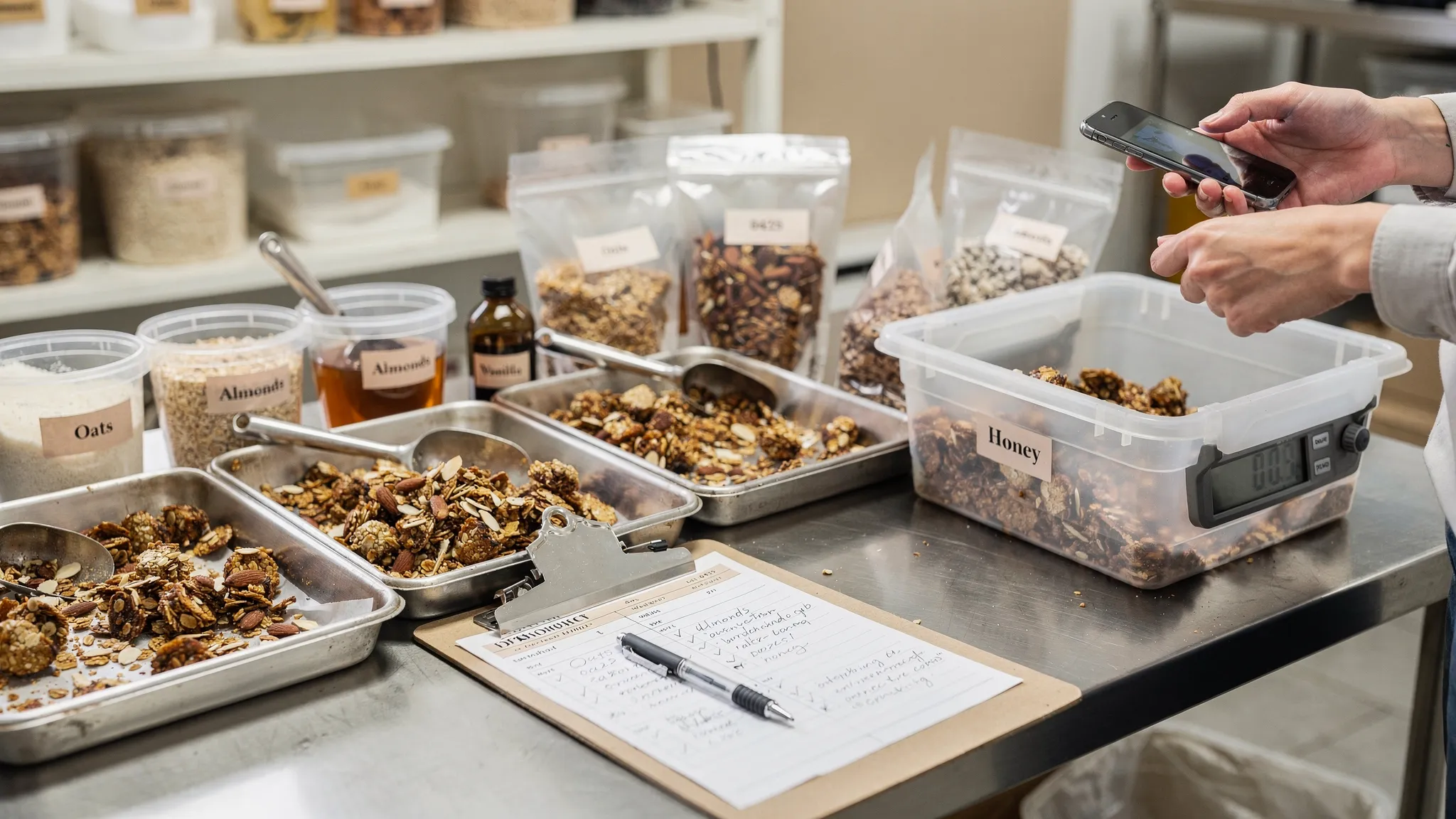
You did not start a food business to babysit spreadsheets. You started it to make something great. The problem is that pricing and margins ride on accurate recipe costs, and spreadsheets rarely keep up with real life. Ingredient prices shift, lots get swapped mid-batch, yields swing, and a messy clipboard wins over a clean cell every time.
Here is the calm, practical way to get accurate costs without changing how you work. Capture the real inputs of each batch, then let batch-level inventory and weighted averages do the math for you. That is the whole play.
The fastest path to accurate recipe cost, no spreadsheets required
To price confidently and protect margins, capture these three things for every batch:
- Ingredient and packaging cost, tied to the actual lots you used, not a catalog price.
- Production time, the minutes you actually spent from prep to pack, using your shop rate.
- Yield and waste, what you planned to make, what you actually got, and what was scrapped or sampled.
When you track this at the batch level, your cost per unit reflects reality. No fragile formulas, no stale "standard cost."
Why spreadsheets keep letting you down
Spreadsheets assume the world is tidy. Kitchens and production rooms are not.
- Prices change by purchase, even by lot. A spreadsheet usually holds one price and hopes you update it.
- Substitutions and split lots are common. A sheet rarely knows which lot ended up in which batch.
- Yields move. Overfill, trim, QC rejects, and samples change your true cost per saleable unit.
- Copy paste errors and version drift add up. One wrong cell can misprice an entire season.
If your costing does not reflect actual lots, actual time, and actual yield, your margins are guesswork.
Batch-level inventory is the only accurate lens
Costing at the batch level means you calculate cost based on what actually happened today, not what you hoped would happen.
- You record the ingredient lots and packaging used.
- You capture production time from your log, then apply your shop rate.
- You count salable units after waste.
Batch Better digitizes the batch log you already fill out, extracting the data you need without changing your workflow. The platform ties those batch facts to your inventory, so the cost of each lot flows into the batch automatically. Then it calculates your cost per salable unit for that batch. For inventory valuation across many batches, Batch Better uses a weighted average across batches, so your on hand cost stays accurate as prices and yields change.
You keep your process. The math gets stronger in the background.
What to capture each time you make a batch
- Ingredients and packaging by lot: item, lot code, quantity, and the lot's actual cost (ideally recorded when received).
- Production time: setup, cook or blend, cool, pack. Use your standard shop rate to convert minutes to dollars.
- Yield and waste: planned units, salable units, rejects or samples. This turns total batch cost into cost per salable unit.
With Batch Better, AI-powered data extraction lifts these details from your existing paper logs, automatic data validation catches obvious errors, and lot label scanning keeps traceability tight.
A simple worked example
You make Cinnamon Almond Granola. One batch targets 40 bags, 300 g each. You planned 40, but 2 bags were lost to QC and samples, so salable units are 38.
Here is Batch A.
| Cost component | Quantity | Unit cost | Batch cost |
|---|---|---|---|
| Oats, lot O1 | 12 lb | 0.85 | 10.20 |
| Almonds, lot A7 | 5 lb | 3.20 | 16.00 |
| Honey, lot H3 | 2.5 lb | 2.60 | 6.50 |
| Oil, lot OL2 | 0.75 lb | 2.00 | 1.50 |
| Cinnamon, lot C4 | 0.2 lb | 5.00 | 1.00 |
| Pouches, lot P9 | 40 each | 0.34 | 13.60 |
| Labels, lot L2 | 40 each | 0.07 | 2.80 |
| Production time | 1.5 hours | shop rate 20.00 per hr | 30.00 |
| Total batch cost | 81.60 |
Salable units: 38. Cost per salable unit: 81.60 / 38 = 2.15.
Next week, almonds cost more and pouches tick up. You make Batch B and lose only 1 bag to QC, so salable units are 39.
| Cost component | Quantity | Unit cost | Batch cost |
|---|---|---|---|
| Oats, lot O2 | 12 lb | 0.85 | 10.20 |
| Almonds, lot A8 | 5 lb | 3.60 | 18.00 |
| Honey, lot H4 | 2.5 lb | 2.65 | 6.63 |
| Oil, lot OL2 | 0.75 lb | 2.00 | 1.50 |
| Cinnamon, lot C5 | 0.2 lb | 5.00 | 1.00 |
| Pouches, lot P10 | 40 each | 0.36 | 14.40 |
| Labels, lot L2 | 40 each | 0.07 | 2.80 |
| Production time | 1.5 hours | shop rate 20.00 per hr | 30.00 |
| Total batch cost | 84.53 |
Salable units: 39. Cost per salable unit: 84.53 / 39 = 2.17.
Inventory on hand after both runs: 38 bags from Batch A and 39 bags from Batch B. Batch Better calculates the weighted average inventory cost as:
Weighted average cost per unit = (38 x 2.15 + 39 x 2.17) / 77 = 2.16.
That 2.16 reflects reality, factoring the actual lots, time, and yield of both runs.
From accurate cost to confident pricing
Once you have a trusted cost per unit, pricing is just math and margin goals. A simple cost plus formula many producers use is:
Price per unit = Cost per unit / (1 - Target margin).
Using the example weighted average cost of 2.16, here is what suggested prices could look like if you set margin targets per channel. You will set your own targets, these are only examples to show how the math works.
| Channel | Target margin | Suggested price |
|---|---|---|
| Retail direct to consumer | 60 percent | 2.16 / 0.40 = 5.40 |
| Wholesale to stores | 40 percent | 2.16 / 0.60 = 3.60 |
| Distributor | 30 percent | 2.16 / 0.70 = 3.09 |
Batch Better shows suggested prices per batch for retail, wholesale, and distributors automatically based on your margin goals, so you do not need to rebuild price sheets when input costs move.
How this works in Batch Better, without changing your workflow
- Keep using your batch sheets and clipboards. Batch Better digitizes them with AI-powered data extraction, so the data you already record becomes structured, searchable, and recall ready.
- Ingredient and packaging lines stay tied to lot codes. Lot label scanning makes it quick, and instant lot tracing keeps audits calm.
- The platform attaches the actual cost from each lot in your inventory record, then adds your recorded production time and your shop rate.
- Cost per salable unit is calculated for the batch after yield and waste. For on hand inventory across batches, Batch Better uses a weighted average across batches so your valuation and pricing reflect reality.
- Set margin targets by channel once. See suggested prices by batch, export reports in one click, and move on with your day.
You get traceability, recall ready records, FEFO based expiry visibility, and accurate costing in the same place. The result is less waste, faster decisions, and healthier margins.
Common pitfalls that quietly drain margin
- Ignoring packaging. Pouches, labels, caps, dividers, and case packs add up fast.
- Using a catalog price instead of lot cost. Last month's price is not this month's cost.
- Costing to planned yield instead of salable units. Overfill and QC rejects belong in the math.
- Forgetting setup and cleanup time. If it is on the clock, it belongs in the batch cost.
- One giant spreadsheet. It looks tidy, but it hides lot swaps, substitutions, and real batch variation.
Quick start checklist
- Add your shop rate and margin targets per channel.
- Scan a recent run's batch sheet. Confirm ingredients, packaging, lots, times, and yield. You can enter any of this data directly if it's not already captured on your batch sheet.
- Review the batch level cost and suggested prices. Export a report if you need it for your price list update.
You get the relief of accurate numbers without adding computer time to your week.
Frequently Asked Questions
Do I need to change how my team fills out batch sheets?
No. Keep your current batch sheets and clipboards. Batch Better digitizes what you already record, then validates and links it to your inventory so costing and tracing happen in the background.
How do I include labor in my recipe cost?
Record production time on the batch log and apply your shop rate. Batch Better includes that time in the batch cost, which then rolls into your cost per salable unit.
What if I split ingredients across lots or make substitutions mid-batch?
Record the lots and quantities you actually used. Because costing is at the batch level, each lot's real cost flows into the batch total, no manual averaging required.
How does waste affect my cost per unit?
Waste and rejects lower the number of salable units. Batch Better divides total batch cost by salable units, so your per unit cost reflects what you can actually sell.
Why use weighted average for inventory cost?
Input costs and yields change by batch. A weighted average across batches on hand gives you a stable, accurate inventory cost for pricing and reporting, without reworking history every time a price moves.
Can I set different margin goals for retail, wholesale, and distributors?
Yes. Set targets by channel once. Batch Better shows suggested prices per batch automatically, so you protect margin across channels.
Price confidently without spreadsheets
If you want to modernize costing without remodeling your workflow, move the math to the batch level and let the averages work for you. You already record the truth on paper. Turn it into recall ready, traceable, and margin safe data with Batch Better.