You make great food. The hard part is proving every jar, loaf, or bar is priced right. Ingredient prices shift, batches run a little short, and the clipboard tells a story only you can read. When the cost of ingredients is unclear at the batch level, margins slip and planning turns into guesswork.
Per-batch costing fixes that without changing how you produce. Capture the real cost of each run, then price and plan with confidence. That is the relief most small producers are looking for.
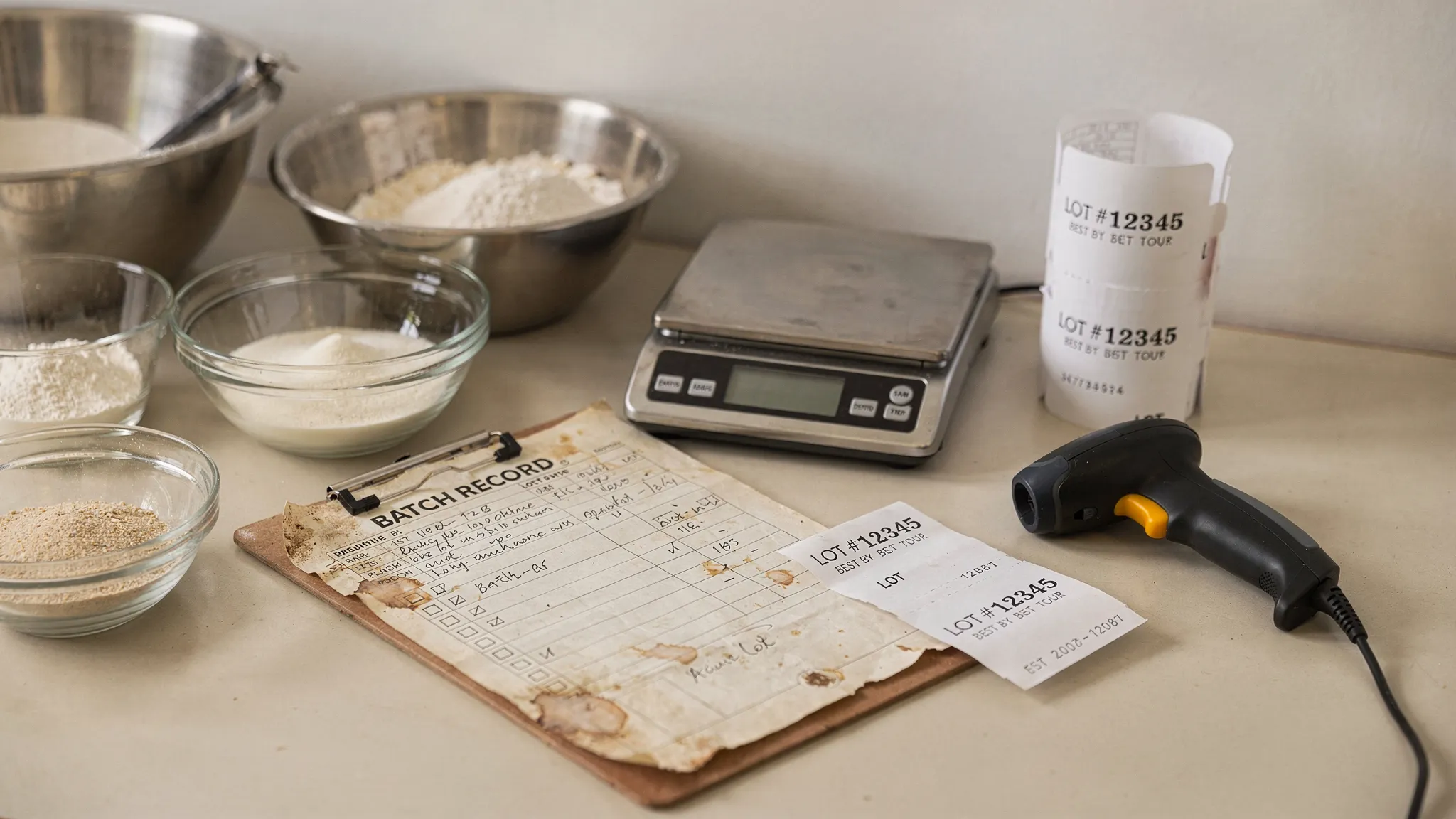
Why batch-level cost clarity matters
- You stop underpricing. The difference between a 28 percent and a 38 percent margin often hides in labels, lids, and labor you forgot to count.
- You respond faster to price swings. Food input prices move. The USDA ERS Food Price Outlook and BLS Producer Price Index show ongoing volatility. Seeing cost per batch lets you adjust price or pack size before it hurts.
- You value inventory correctly. Knowing what a lot actually cost keeps your books accurate and your conversations with lenders and accountants straightforward.
- You plan production with facts. When unit cost is solid, forecasting and promotions stop being risky guesses.
What belongs in a batch cost
Think in plain buckets. If it went into the batch or was required to run it, it belongs.
| Component | What to capture | Why it matters | Where it hides |
|---|---|---|---|
| Ingredients | Quantity used from each lot and the price you paid for that lot | Captures real cost and price swings | Vendor invoices, purchase orders, handwritten notes |
| Packaging | Primary pack, closures, labels, case boxes, dividers | Often missed, but it hits margin directly | Supply closet counts, case pack slips |
| Direct labor | Time on prep, cook, fill, pack, clean for that batch | Real labor per run, not averages | Whiteboard tallies, timecards |
| Variable overhead | Energy, water, sanitizer, wear items tied to production | Small amounts add up across runs | Utility rates, consumables per run |
| Allocated fixed overhead | A fair share of rent, equipment, QA, depreciation | Smooths big costs into steady unit cost | Monthly totals prorated by time or machine hours |
| Yield and scrap | Sellable units after overfill, spill, QC hold, rework | Unit cost is about sellable units, not theoretical ones | End-of-run counts on the batch sheet |
A simple formula you can use today: Batch cost equals ingredients plus packaging plus direct labor plus variable overhead plus allocated fixed overhead, then divide by sellable units to get unit cost.
A quick example from a real batch sheet
You ran 120 jars. After QC, 116 are sellable.
- Ingredients: $73.50
- Packaging: $72.80
- Direct labor: $108.00
- Variable overhead: $4.00
- Allocated fixed overhead: $15.00
Batch cost: $273.30
Unit cost: $273.30 divided by 116 equals $2.36
If your old spreadsheet missed labels and labor and told you $1.90, you are short $0.46 a jar. On 116 jars, that is $53.36 of margin gone in one small run. Multiply that by a month and it is real money.
Where batch costs go wrong in the real world
- Ingredient price drift. You copy last month's sugar price and miss a 12 percent jump.
- Unit mix-ups. The recipe is in pounds, the invoice is in kilograms, the batch sheet says bags.
- Substitutions. A different vendor or pack size slips into the run, and the cost never updates.
- Packaging blindness. Jars and labels feel cheap, so they vanish from the math.
- Labor averages. You divide last week's hours across all products and bury real differences.
- Yield optimism. The recipe says 120, but you sell 114 to 118 most days. Unit cost should reflect what you can actually sell.
None of this is a systems failure. It is the reality of busy production. The fix is to make it easier to capture facts from the batch that just happened.
Make batch costs automatic without changing your workflow
Batch Better digitizes the paperwork you already use, then calculates cost per batch with ingredient, packaging, and production costs. You keep your clipboards. The intelligence works in the background.
Here is how it removes the friction:
- AI-powered data extraction reads your existing batch records and turns them into structured data. No new forms to learn.
- Lot label scanning links the exact lot you used to the batch. The platform brings in the price you paid for that lot.
- Batch level costing rolls up ingredients, packaging, direct labor and allocations into a clean unit cost.
- Automatic data validation flags unit conflicts and outliers before they become accounting errors.
- Real-time inventory tracking updates quantity and cost on hand as you consume lots and finish goods.
- Expiry and FEFO tracking helps you plan runs that use what is closest to expiry first, which reduces waste that quietly raises unit cost.
- One-click export reports give your accountant, buyer, or auditor what they need without end-of-month scrambling.
- Instant lot tracing ties cost to traceability. If you ever need to isolate a lot, you also see the financial exposure quickly.
You do not have to rewire your process. Keep making product, and let the system turn what you already write down into recall-ready, margin-friendly records.
Decisions you can trust once costs are clear
- Pricing. See unit cost by batch, then set price or pack size to hold margin.
- Promotions. Model a short-term discount against current ingredient cost, not last quarter's.
- Vendor negotiating. Spot the drivers of cost and ask for quotes where it matters.
- Production planning. Pair unit cost with repurchase prediction and production forecasting to schedule profitable runs.
- Inventory value. Know exactly how much money is sitting on the shelf and which lots should move first.
Set this up in an afternoon
- Pick your top three SKUs and pull the last two weeks of batch sheets.
- Grab the latest invoices for each ingredient and packaging item.
- Note actual sellable units per run and a reasonable labor rate.
- Scan the paperwork into Batch Better, tag your ingredient and packaging lots, and let the platform calculate unit cost per batch.
No process overhaul. Just clarity.
Compliance and traceability fit naturally
Cost by batch and lot-level traceability go hand in hand. The FDA's Food Traceability Rule supports stronger record keeping for certain foods. If you are adding more lot detail for compliance, you might as well get margin clarity from the same records. See the FDA overview of the rule here: FDA Food Traceability Rule.
Frequently Asked Questions
Do I really need to include labor and overhead in my batch cost?
Yes. Ingredients and packaging are only part of the picture. Direct labor and a fair allocation of overhead give you the true unit cost, which is what pricing should be based on.
What is a simple way to allocate overhead per batch?
Pick a driver that reflects effort, like labor hours or machine hours. If rent and insurance are $3,000 a month and you run 150 labor hours, that is $20 an hour. A 2 hour batch gets $40.
How does Batch Better get data from my paper logs?
The platform digitizes the batch records you already fill out. It reads quantities, lots, and times, then calculates cost automatically. You can keep your current forms and workflow. If you don't record these items on your forms, you can enter them directly into Batch Better.
What if my supplier prices change every week?
Because costs are tied to the actual lot you used, new prices flow into the batch the ingredient is used in automatically. You will see the impact on unit cost right away.
Can I track packaging costs too?
Yes. Packaging is part of batch level costing, including jars, lids, labels, and case materials.
Will this help my accounting and audits?
Yes. One-click export reports give your accountant clean COGS support, inventory value, and lot-level detail. It also makes audits faster because your records are recall-ready.
How does this reduce waste?
Expiry and FEFO tracking helps you plan runs using the right lots at the right time. Less expired stock means lower unit cost over time.
Make the cost of ingredients clear for every batch
When the numbers match the reality on your tables and kettles, pricing gets easier, recalls get simpler, and margins stop leaking. If you want batch-level cost and inventory value without changing your process, take a look at Batch Better.
Start here: Batch Better