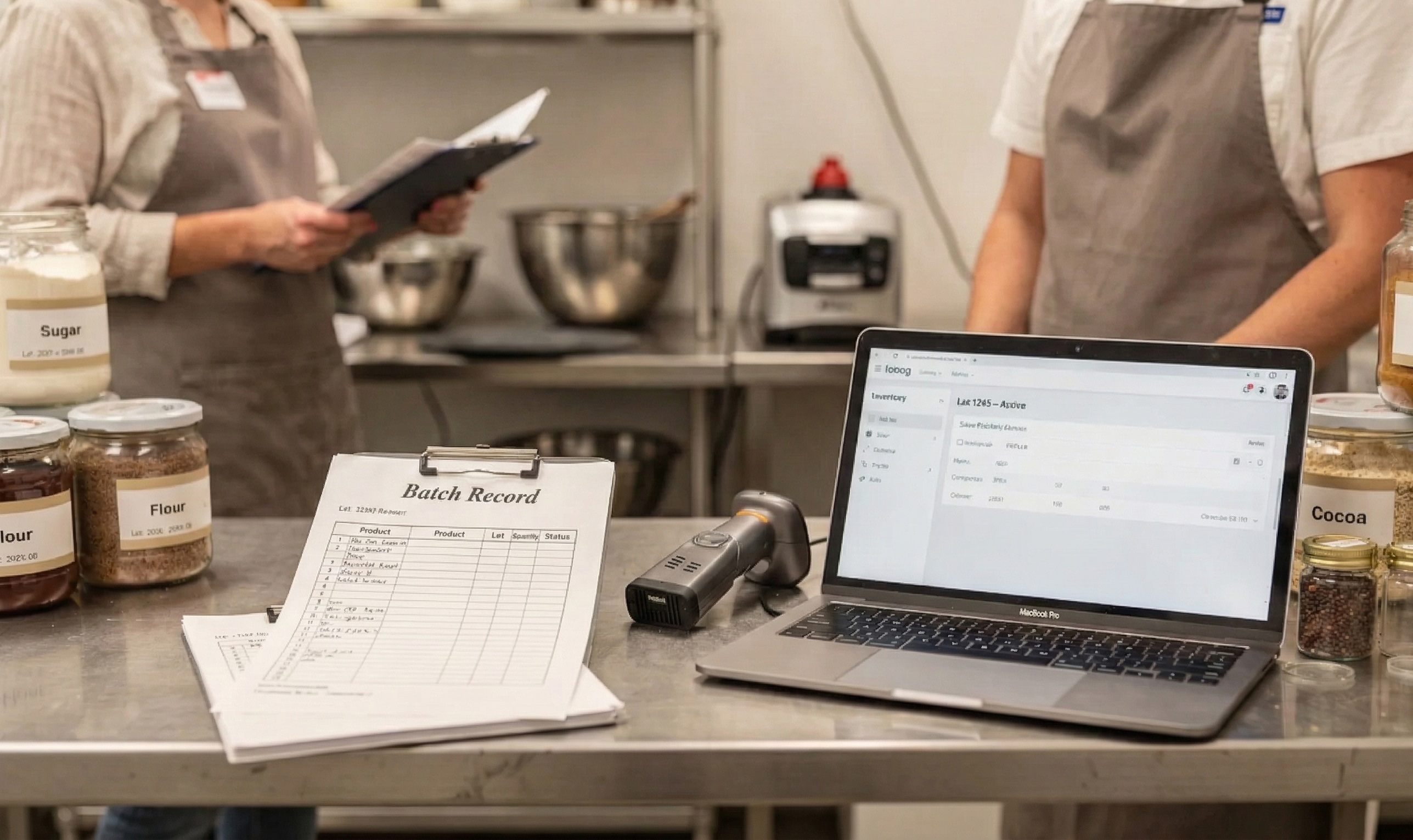
You did not start your business to wrestle with spreadsheets. You built it to make great food and drink. Yet as orders grow, those tabs and clipboards start running the show. Ingredients go missing, yields drift, and audits turn into fire drills. This is the gap where manufacturing resource planning, done the right way for food producers, brings relief and margin back to your week.
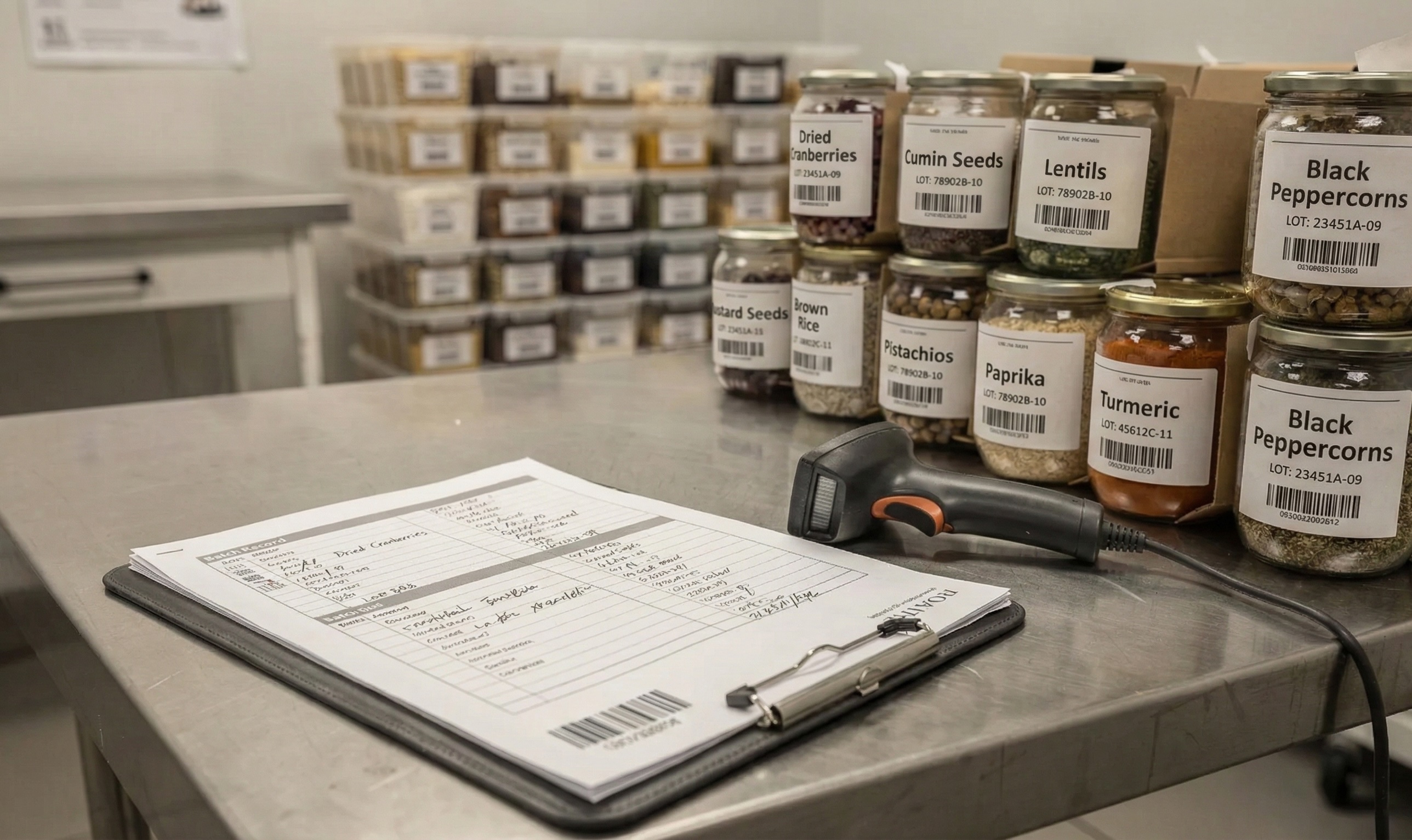
What manufacturing resource planning means in a small food plant
Manufacturing resource planning, or MRP, is simply the discipline of turning demand into the right production plan with the right materials, at the right time. For food producers, it has a few non-negotiables that generic systems often miss:
- Recipes are bills of materials, with substitutions and variable yields.
- Inventory is tracked by batch and lot, not just item, with expiry dates attached.
- Picking should follow first expired, first out, not first in, first out.
- Every batch must be traceable, backward to ingredients and forward to customers, so recalls are fast and contained.
- Forecasts should respect seasonality, launch spikes, and distributor reorders.
If your current system does not handle those basics without workarounds, you feel it as waste, stockouts, and long hours reconciling paper.
The spreadsheet ceiling
Spreadsheets work, especially in the early days. They are flexible and cheap. But the cracks show as volume increases and the product line expands:
- Version drift, someone updates a formula in one file and the inventory picture changes in another.
- Slow tracing, linking ingredient lots to finished goods takes hours of detective work.
- Expiry surprises, aging inventory hides until it expires, then gets dumped.
- Yield blind spots, the recipe says 95 percent but last week you got 88 percent and no one adjusted the next plan.
- Fire drill audits, pulling production records and proof of lot movements eats a day you did not have.
These are not just annoyances. They are margin leaks. The lack of real time insight directly increases waste, slows production, and makes recalls riskier than they need to be.
According to the USDA, food loss and waste in the United States is substantial, which increases costs across the chain. Better inventory visibility and expiry control can reduce that burden in a plant like yours. See the USDA overview on food loss and waste for context.
Why big-box MRP or ERP often does not fit food
Traditional MRP and ERP suites were built for discrete manufacturing. They expect part numbers and work orders, not brine loss, bulk-to-pack conversion, or FEFO rules. They can be powerful, but for many small producers they are expensive, slow to adopt, and ask you to change your shop to fit their screens.
If you have tried a generic inventory app, you probably hit the same wall. It tracks quantities, but it does not think in lots, expiry, and yield variance. You end up backfilling with spreadsheets just to make it work for food.
A targeted path: MRP built for food producers
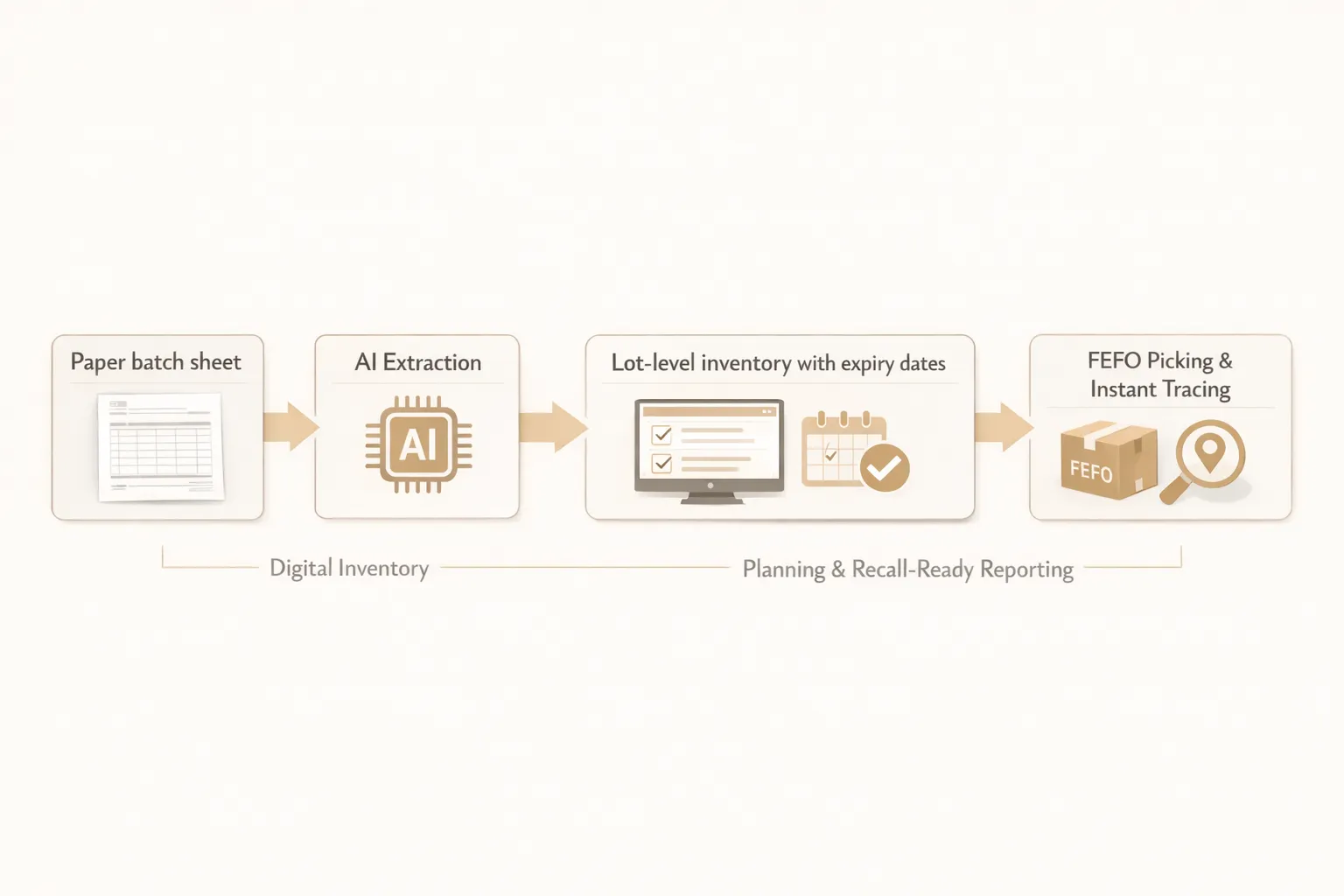
Batch Better was designed to fill this gap. It gives you the core of manufacturing resource planning for food, without forcing a big system change. The platform converts the records you already create into structured, traceable data, then uses that data to plan production and protect margin.
Here is how it delivers value quickly, using the tools you already have:
- AI-powered data extraction, Batch Better digitizes paper batch logs and receiving sheets, then checks them with automatic data validation. You keep your clipboards, but the data becomes recall ready.
- Batch-level inventory and instant lot tracing, every movement is tied to a lot. You can trace backward to ingredients and forward to finished goods in seconds, with one-click export reports for auditors and customers.
- Expiry and FEFO tracking, the system tracks dates and builds FEFO pick lists, so your team grabs the right lot without guesswork.
- Lot label scanning, print or scan labels to move lots, count inventory, and pack orders without typing.
- Recipes and yield management, manage bills of materials, track real yields by batch, and adjust plans based on what actually happens on the line.
- Production forecasting and repurchase prediction, plan batches around distributor reorders and retail velocity. Get ahead of seasonality and launches.
- Batch-level costing, see the real cost of each batch, including yield impact, and fix the worst offenders first.
You get modern MRP outcomes, planning, traceability, and inventory accuracy, with less change management and at a reasonable price.
How options compare for food production
| Need that matters in food | Spreadsheets | Generic MRP or IMS | Full ERP | Batch Better |
|---|---|---|---|---|
| Expiry and FEFO picking | Manual formulas and notes | Often missing or FIFO focused | Configurable, high effort | Built in for food lots |
| Lot-level traceability | Time consuming manual lookup | Partial, add-ons needed | Robust, complex setup | Instant lot tracing |
| Recipes and yield variance | Static sheets, error prone | Basic BOM, limited yield tracking | Advanced, heavy to maintain | Recipes with yield management |
| Real-time inventory by batch | Difficult to maintain | Item level, not lot aware | Possible with customizations | Real-time, lot aware |
| Recall-ready records | Manual packet assembly | Exports require cleanup | Strong but complex | One-click export reports |
| Label scanning | Add-on or none | Varies by vendor | Yes, hardware heavy | Lot label scanning |
| Setup time | Immediate, but fragile | Weeks, retraining needed | Months, change management | Start fast, keep workflows |
| Ongoing cost | Hidden labor cost | Medium to high | High | Reasonable, focused scope |
A 30-60-90 day plan that respects your kitchen
You do not need a drawn-out project plan. You need results that free time and reduce waste.
- First 30 days, digitize what you already do. Use AI-powered data extraction to turn paper receiving logs and batch sheets into structured lots. Our automatic data validation will catch missed fields early. Start scanning lot labels for movements.
- Days 31 to 60, enable FEFO and tracing. Activate expiry and FEFO rules so pick lists point to the right lots. Use instant lot tracing to rehearse a mock recall. Export the report in one click to prove you can do it under pressure.
- Days 61 to 90, plan and optimize. Load recipes, track real yields by batch, then tune batch sizes and schedules. Turn on production forecasting and repurchase prediction so you plan to demand, not to hope. Review batch-level costing to find quick margin wins.
Each step delivers value on its own. Together, they replace spreadsheet guesswork with a calm, clear picture of production.
Two quick scenarios
- Jam and preserves kitchen, yields swing with fruit quality. Batch Better captures actual yield per batch, updates batch-level costing, and adjusts the next plan. Expiry and FEFO ensure cases packed last month do not hide behind this week's run.
- Craft soda producer, many micro lots of flavor syrups and packaging. Lot label scanning speeds counts. Instant lot tracing links sugar and acidulates to finished cases in seconds, so distributor audits are quick.
Proving ROI without a spreadsheet gymnastics act
Track a few simple metrics for 90 days and compare to your last quarter:
- Percent of inventory written off due to expiry.
- Time to produce a complete lot trace report.
- Stockouts that delayed or split a production run.
- Average yield vs recipe yield, by product.
- Hours spent preparing for audits or customer documentation.
Most teams see early wins from FEFO alone, then pick up steady gains from yield management and better forecasts.
About audits and traceability
Food traceability expectations are rising. The FDA Food Traceability Rule, FSMA 204 has stricter traceability standards for covered foods. Even if you are not directly covered, buyers and auditors now expect clear records. Batch Better supports recall-ready record keeping, instant lot tracing, and one-click export reports, which makes audit prep faster. For the rule itself, see the FDA overview.
Why the approach matters
You have a production rhythm that works. The goal is not to rip it out. The goal is to modernize it just enough that you stop losing money to time, waste, and uncertainty. Targeted manufacturing resource planning for food gives you that relief without the weight of a full ERP.
Frequently Asked Questions
What is manufacturing resource planning for a food producer? It is the process and tooling that turns demand into the right production schedule and material plan, tied to recipes, lots, expiry, and traceability, so you can make and ship on time without firefighting.
Do I need to change my workflows to use Batch Better? No. Batch Better was built to digitize the logs and batch sheets you already use, then layer lot tracking, FEFO, and planning on top. You keep your clipboards, and the data becomes traceable and usable in real time.
How does traceability work if we still use paper? Batch Better uses AI-powered data extraction to convert your paper records into lot-level data, then links ingredients to finished batches. Instant lot tracing lets you pull backward or forward records in seconds and export a complete packet in one click.
Will this help with FSMA 204 and audits? Batch Better supports recall-ready record keeping, instant lot tracing, and organized exports, which simplifies audit prep. For regulatory scope and requirements, always refer to the FDA and your compliance advisors.
How is this different from an ERP? ERPs try to do everything. They can be powerful, but they are heavy to implement and maintain. Batch Better focuses on the parts that matter most to small food producers, traceability, expiry, FEFO, recipes, yields, and planning, without the bloat.
How fast can we see value? Teams typically see immediate value from digitized records and expiry control in the first month. Yield insights and forecasting gains build in the second and third months.
Does this work for beverages and variable yields? Yes. Recipes with yield management and batch-level costing are designed for products where yields fluctuate based on ingredients, temperature, or process.
Ready to take the paperwork drag out of production?
If you want MRP outcomes without an ERP overhaul, start where you are. Digitize a week of batch sheets, turn on FEFO, and run a mock trace. You will feel the relief right away.
Take the next step with Batch Better. See how targeted manufacturing resource planning for food can reduce waste, speed audits, and make planning calm again. Visit Batch Better to get started.