Quick refresher: what a traceability lot code must do
A traceability lot code is the unique ID you assign to a batch or production run. It ties ingredients, process, location, and time together so you can trace forward (who received what) and trace back (where it came from).
A good lot code is:
- Unique for every finished lot
- Consistent in format, including changeovers and overtime
- Linked to supplier lot codes for every ingredient used
- Present on unit, case, and pallet labels, and recorded on your batch sheet or production log
- Optionally scannable if you use GS1 barcodes or QR
If you label with GS1 barcodes, you can include the batch or lot using GS1 Application Identifier (10). Learn more in the GS1 guide to Application Identifiers. If you produce foods on FDA's Food Traceability List, FSMA 204 requires a traceability lot code and specific records, with a compliance date of January 20, 2026. See the FDA's overview of the Food Traceability Final Rule.
Pocket checklist
Use this as a daily quick check. No new software is required. A pen, your current batch sheet, and clear labels are enough.
1) Receiving
- Record supplier name, item, quantity, date, and the supplier lot code exactly as printed on cases.
- If breaking pallets, carry the supplier lot forward to all partials and opened cases.
- Apply or capture a receiving label that includes date and your internal item code.
- Flag any missing or illegible supplier lot codes before ingredients hit storage.
2) Pre-production staging
- Assign the internal traceability lot code for today's batch before the first ingredient hits the scale.
- Write the internal lot code on the batch sheet.
- Stage only the ingredients you will use, keep supplier lot labels visible.
- Note substitutions and short picks, link to the actual supplier lot used, not what the recipe calls for.
3) Production and mixing/cooking
- Record start time, line or kettle, and operator initials on the batch sheet.
- Capture every ingredient lot used, supplier lot to internal lot linkage is the backbone of traceability.
- For multi-stage runs, note changeovers by time and restart sequence numbers to protect uniqueness.
- Log yield, scrap, and any rework pulled in. Rework must list its source lot code.
4) Cooling, filling, and packaging
- Apply unit and case labels with the internal lot code and pack date, include use by or best by if used.
- Verify label placement, not on seams, not under tape, not where condensation will blur ink.
- If you print barcodes, scan a sample from the first and last cases of each run.
5) Storage and FEFO
- Place finished cases into the correct zone immediately, cold holds get priority.
- Mark pallets with lot code, expiration or best by date, and total cases. Use pallet placards for easy finding.
- Organize inventory with the newest products furthest back to help with FEFO (first expiring, first out).
6) Picking and shipping
- Pick by FEFO, selecting the closest expiration dates.
- Record customer, ship date, quantity, and every lot code shipped on the pick ticket.
- For mixed-lot shipments, list all lots on the paperwork.
7) Rework, returns, and disposals
- For rework, link the source lot to the new finished lot, record the proportion used.
- For returns, capture customer, reason, quantity back, and the lot code returned.
- For disposals, record lot, quantity, and why it was scrapped.
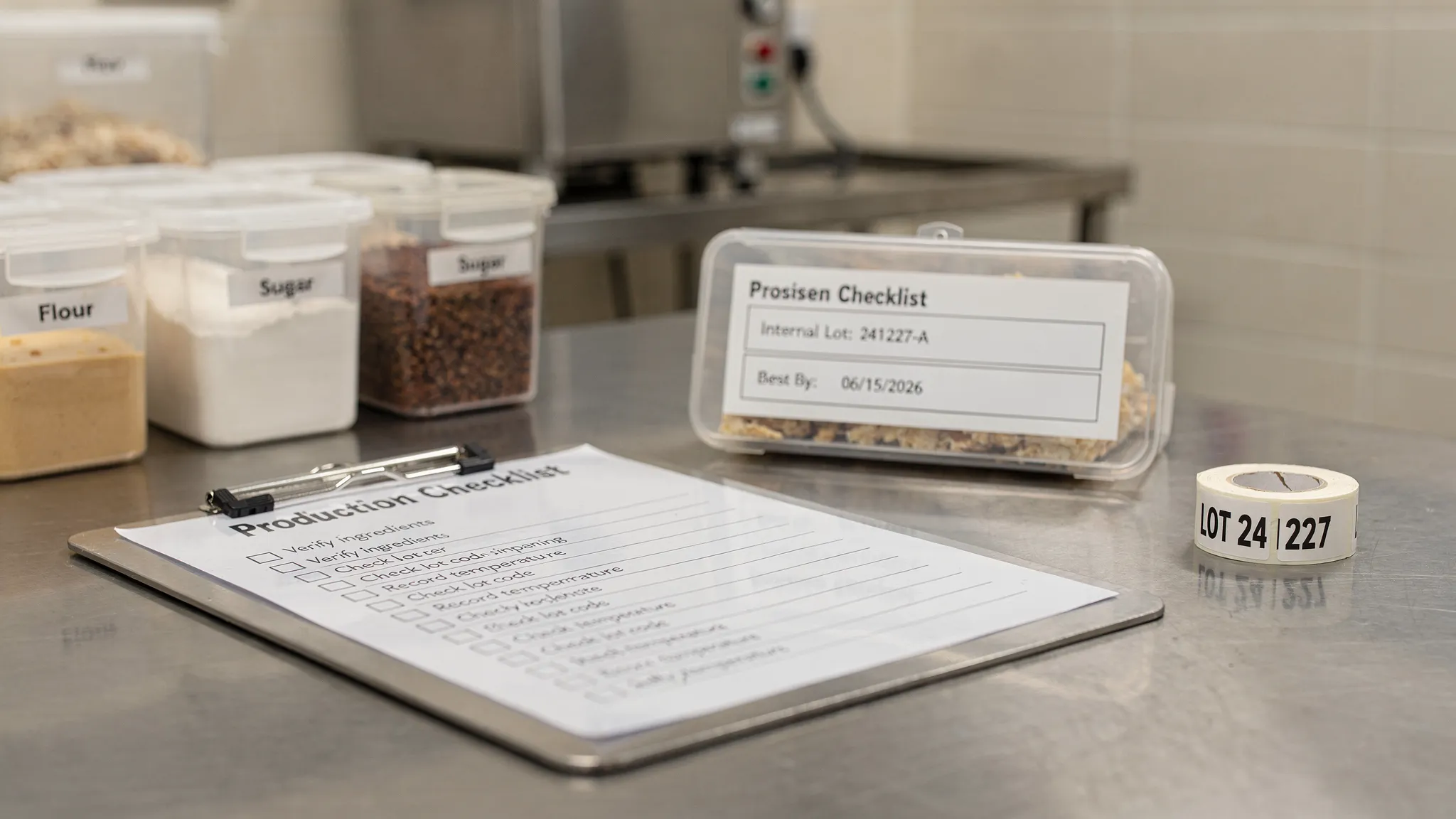
Recommended lot code format, simple and durable
Keep it short, human readable, and predictable under pressure. Two formats most teams adopt:
| Format | What it encodes | Example | Why it helps |
|---|---|---|---|
| Prefix-JulianDate-Line-Sequence | Brand or plant prefix, day of year, line or kettle, sequence or shift | BB-24058-L2-03 | Compact, easy to write, never repeats during the year |
| YYYYMMDD-Line-Batch | Calendar date, line, sequence | 20250301-L1-02 | Clear date, simple to train new staff |
Do and do nots:
- Keep the code under 16 characters so it fits on small labels.
- Do not reuse a code, even if a run is tiny or scrapped.
- Do not rely on marker only, use pre-printed or printed labels when possible.
If you use GS1 barcodes, add AI (10) for lot and AI (17) for best before if applicable, this keeps human and machine data aligned.
Five-minute daily habits that prevent hour-long fire drills
- First case check, confirm lot code, best by, and label scan before the run ramps.
- Mid-run check, confirm the batch sheet still matches what you are actually using.
- Last case check, scan or note the final case lot and quantity.
- Post-run tidy, park partials with clear lot tags and update the whiteboard.
Handle changeovers, partials, and rework without chaos
- Changeovers, start a new sequence, keep the date and line so uniqueness holds.
- Partials, tag partial bags, tubs, and pallets with the supplier lot or internal lot before storage.
- Rework, never blend anonymously, always link the source lot into the new batch sheet.
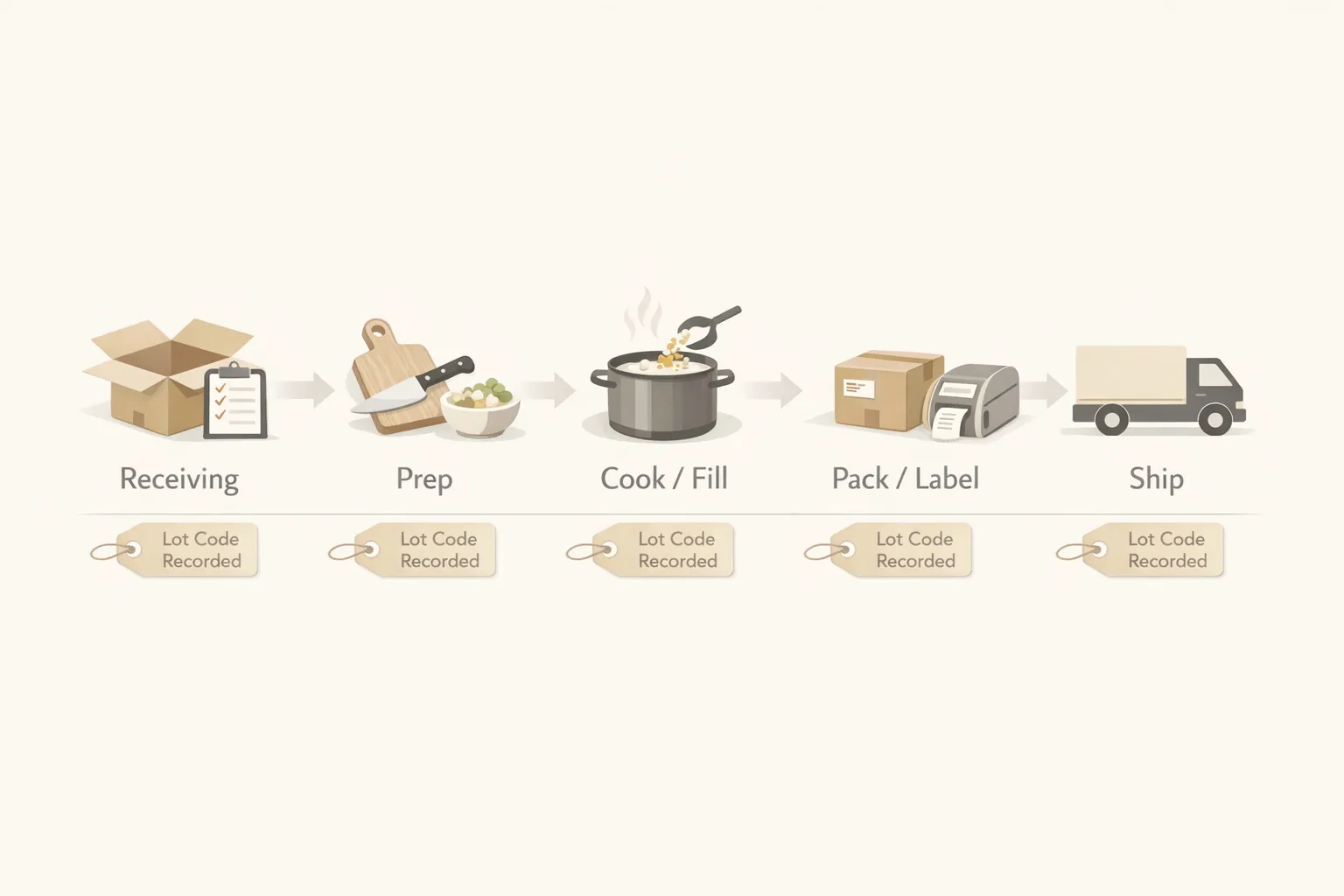
Traceability lot code touchpoints that satisfy audits and speed recalls
The same data that calms an audit also shortens a recall. Keep it focused on the essentials.
| Step | Minimal records to keep on hand | Target granularity |
|---|---|---|
| Receiving | Supplier, item, quantity, date, supplier lot code, storage location | Per delivery lot |
| Transformation/Production | Internal lot code, start time, line, operator, all ingredient supplier lots, yield | Per batch |
| Packaging | Labels applied, case and pallet counts, best by or use by | Per run |
| Shipping | Customer, ship date, quantity, lot codes shipped, carrier/BOL | Per shipment |
| Corrections | Rework linkage, returns, disposals with lot and quantity | Per event |
Tip: do one quick recall drill monthly. Pick a shipped case, trace back to all ingredient lots and forward to all customers who received that finished lot. Time the drill. Under 10 minutes is a strong program.
Common snags and fast fixes
- Illegible codes, switch to high-contrast labels and test in the cooler.
- Missing supplier lots, require them at receiving and reject or relabel before put-away.
- Codes under tape, move placement to a dry, flat face of the case and retrain on day start.
- Split runs not recorded, add a simple sequence box to the batch sheet so operators tick 01, 02, 03.
Turn your paper into recall-ready data without changing the routine
You do not have to replace clipboards to get real-time traceability. Batch Better reads the logs you already fill out, then gives you:
- Instant lot tracing, search an internal lot and see every ingredient and where it shipped.
- Recall-ready record keeping and one-click export reports, send auditors what they ask for in minutes.
- Real-time inventory with expiry and FEFO tracking, pick smarter and waste less.
- Automatic data validation, catch missing supplier lots or odd yields before they snowball.
- Lot label scanning and AI-powered data extraction, no retyping at the end of a long shift.
If you want the relief of clean traceability without a big system change, start where you are. Keep your sheets, add this checklist, and let Batch Better do the heavy lifting in the background. See how it works at Batch Better.
Mini template you can copy onto a 4x6 card
- Our internal lot format: ________
- Where to write it, batch sheet line: ________
- Where it goes on labels, unit/case/pallet: ________
- First case check by: ________ time: ________
- Last case check by: ________ time: ________
- Weekly 10-minute drill, day and owner: ________
Real food is messy, especially when the line is hot and orders stack up. A consistent traceability lot code and a short checklist turn that mess into margin. Less waste, faster audits, calmer recalls, more time for the work that actually makes your product great.
Check out Batch Better for instant traceability of your traceability lot codes without changing your workflow.