Food producers face intense pressure to make track and traceability reliable, fast, and cost effective. Retailers expect instant answers, consumers expect transparency, and regulators expect electronic, sortable data on demand. The good news is that you can reach recall-ready traceability without blowing up your shop floor processes, by digitizing the records you already create and tightening a few critical controls.
What track and traceability means for food producers
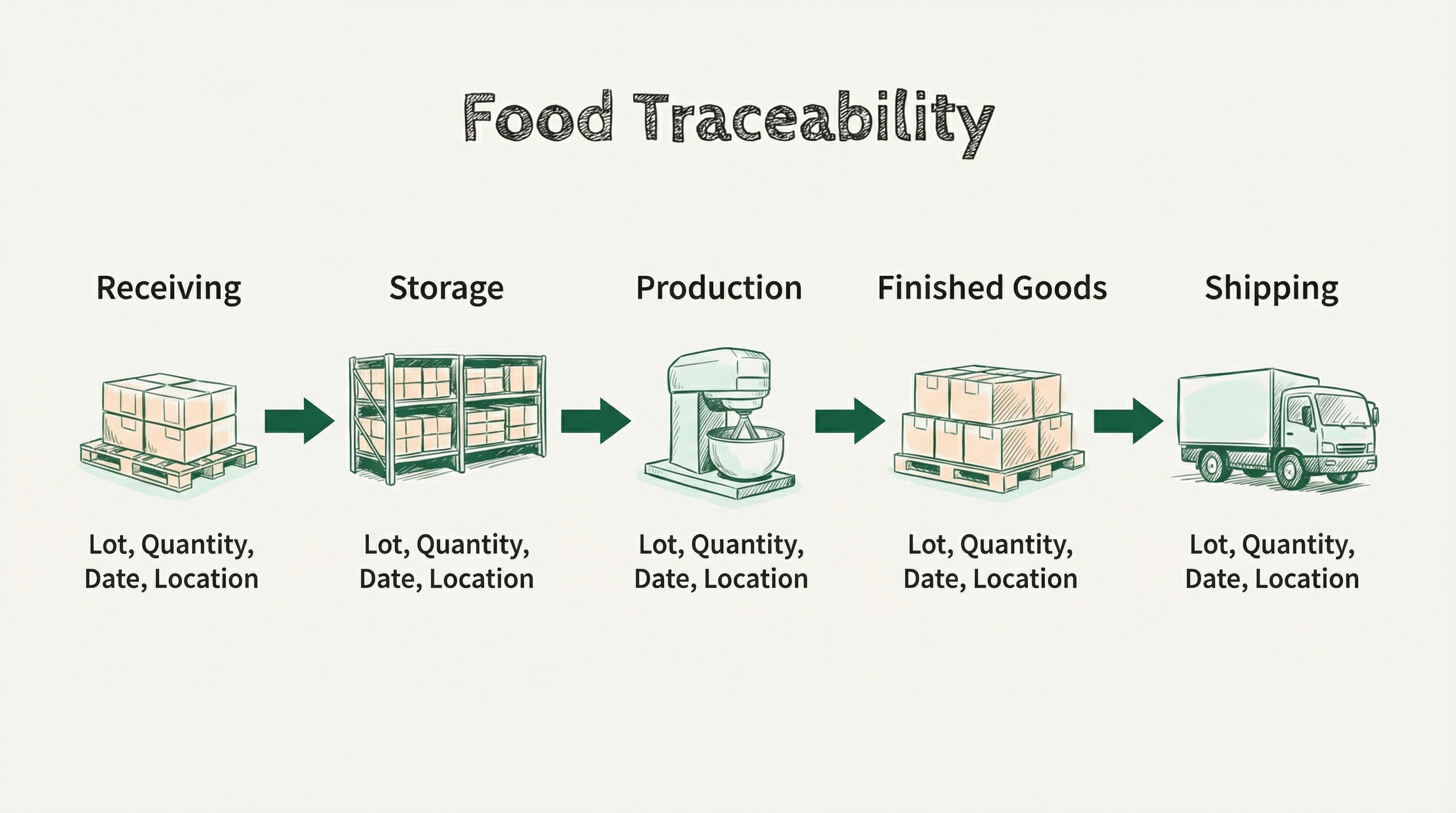
Track and traceability, sometimes shortened to track and trace, is the ability to follow ingredients and finished goods through receiving, production, storage, and distribution, then reconstruct that path quickly and accurately. In practice, it covers two dimensions:
- Internal traceability — connecting inputs to outputs inside your facility so you can see which lots flowed through which batches, lines, and work orders.
- External traceability — documenting one step up and one step down so you know exactly which supplier lots you received and which customers received which finished good lots.
For producers, the goal is simple to state and hard to do well: answer a targeted question fast. Which customers did we ship any finished goods that contain supplier lot ABC123? The systems, labels, and logs you maintain are only as good as the time it takes to produce a correct answer during an incident.
Why 2026 is a pivotal year
January 2026 was the original compliance date for the FDA's Food Traceability Rule, also known as FSMA 204, which applies to foods on the FDA's Food Traceability List. It has since been delayed to July 2028, but many wholesalers are putting compliance systems in place already, knowing it takes time to fully implement. That means 2026 is the perfect time to close gaps and rehearse your response process to maintain key wholesale accounts and prepare your business directly for the rule enforcement. Companies will be required to capture specific Key Data Elements at Critical Tracking Events and to provide data to FDA in an electronic, sortable format upon request.
- Learn more: FDA Food Traceability Rule (FSMA 204)
- Covered foods list: FDA Food Traceability List
- Practical guidance: FDA Small Entity Compliance Guide
Producers not directly covered by FSMA 204 still benefit from stronger track and traceability, since customers and auditors increasingly expect consistent lot-level visibility.
The building blocks of modern traceability
1) Lot coding that works on the floor
A useful lot code is unique, legible, and available wherever the product travels. Best practices include encoding line, date, and shift inside a simple pattern, training operators to record lot codes consistently, and putting the lot on every label that can plausibly be separated from its case or pallet.
Barcodes help reduce transcription errors. If you use GS1 standards, common Application Identifiers include (01) for GTIN, (10) for batch or lot, and (17) for expiration date. See GS1 guidance for details.
2) Critical Tracking Events and Key Data Elements
FSMA 204 defines several Critical Tracking Events across the chain, for example growing for produce, receiving, transforming, creating, cooling for certain foods, and shipping. At each event, companies must capture specific Key Data Elements that tie product, lot, time, quantity, and location together.
| Critical Tracking Event | What to capture, typical KDEs | Example source documents |
|---|---|---|
| Receiving | Supplier, item identifier, lot or traceability lot code, quantity, unit of measure, date, receiving location | Bill of lading, intake log, COA |
| Transforming | Inputs with lot and quantity, process date and line, outputs with lot and quantity, work order or batch ID | Batch sheet, production record |
| Creating | Item identifier and lot assignment when a product is first created or initially packed, date and location | Packout log, line sheet |
| Shipping | Customer, ship date, item identifier, lot, quantity, ship from location | BOL, ASN, pick list |
Note: the FDA rule specifies what is required based on food and role. Use the FDA resources above and your counsel to confirm the KDEs that apply to your products.
3) FEFO and expiry discipline
First Expired, First Out (FEFO) is a practical policy that cuts waste and protects customers. FEFO requires two things: consistent capture of expiration or best by for every lot and inventory visibility that prioritizes picks by date. When you combine FEFO with accurate lot-level balances, you can lower write-offs and prevent short-dated shipments.
4) Electronic, sortable records
During an incident, the difference between a targeted withdrawal and a sweeping recall often comes down to data structure. If you can export a clean spreadsheet of lot movements that links supplier lots to finished goods and customers, your response is faster and narrower. The rule allows a range of systems, the key is that you can produce required data quickly in an electronic, sortable form.
What track and traceability delivers beyond compliance
- Faster, narrower recalls — because you can trace precisely which finished goods contain the affected input lots.
- Lower waste — because expiry data and FEFO are actionable in daily picking.
- Fewer chargebacks and returns — because proof of lot and shipment details are easy to provide.
- Smarter production planning — because you see the material that will expire or stock out first.
Industry analyses consistently show that product recalls are costly in direct expense and brand damage. A modern, data-driven traceability process does not eliminate risk, but it limits the scope of corrective actions and the time your team spends hunting for answers.
A 90-day plan to upgrade traceability without disrupting production
- Map your process from dock to door — list where lots move or change form, and identify the documents or screens operators already touch at each step.
- Standardize your lot schema and label placement — decide where lot codes are created and how they are printed or applied, then train supervisors on the new standard.
- Digitize the records you already keep — use AI-powered extraction to capture data from paper batch sheets, intake logs, and shipping forms so operators do not need to change routines.
- Close the links between inputs and outputs — ensure each finished lot can be tied back to specific input lots with quantities and dates.
- Capture expiry and FEFO details — require expiration or best by dates wherever known and make sure your inventory view can prioritize by date.
- Run a mock recall — choose a supplier lot from 30 to 60 days ago, trace it forward to customers and finished lots, and time the exercise end to end.
- Automate your exports and reports — build a one-click report that shows receiving, transformation, creation, and shipping events for any lot code.
The key is to layer digital capture on top of existing workflows, then gradually replace manual steps where they slow you down.
Metrics that show your system is working
- Time to trace — minutes from selecting a supplier lot to a complete list of finished lots and customers.
- Data completeness — percentage of production records with all required Key Data Elements captured.
- Scan or capture rate — share of lots touched by barcode scan or validated data entry rather than manual typing.
- Mock recall frequency and pass rate — number of successful drills per quarter.
- Waste related to expiry — value written off due to expiration, tracked monthly.
Common pitfalls to avoid
- Combining lots without recording the combination — which breaks backward traceability.
- Changing lot codes mid run or reusing codes across lines — which creates ambiguity.
- Missing rework genealogy — inputs from rework bins must be tied to prior lots.
- Inconsistent product naming across purchasing, production, and shipping — which makes data stitching harder.
- Partial pallet movements without labels — which leads to orphan inventory.
- Co-packer blind spots — when third parties change lots or units and do not return records promptly.
Data standards that make life easier
Standards are optional for many food categories, but they reduce friction with customers and suppliers.
- Product identifiers — Global Trade Item Numbers map cleanly to UPCs and customer systems.
- Barcodes and application identifiers — include GTIN, lot, and expiry where relevant so scanners capture what matters. See GS1 application identifiers.
- Event data — some teams publish or consume EPCIS to exchange shipment and transformation events with partners.
Adopting standards where practical improves data quality and shortens customer onboarding.
How Batch Better supports track and traceability
Batch Better digitizes paper logs for food producers, turning them into traceable, recall-ready inventory data without forcing process change. This approach meets teams where they are, which matters in busy plants where retraining every operator is not realistic in the short term.
Here is how the platform aligns with the upgrades outlined above:
- AI-powered data extraction — capture Key Data Elements from batch sheets, intake logs, and packout forms with minimal operator input.
- Recall-ready record keeping and instant lot tracing — link supplier lots through transformation to finished goods and customers so you can answer traceability questions in minutes.
- Real-time inventory tracking and lot label scanning — see balances by lot and location as work happens.
- Expiry and FEFO tracking plus automatic data validation — reduce waste and catch common errors before they spread.
- One-click export reports — provide the electronic, sortable data auditors request without manual compilation.
- Growth features like repurchase prediction and smart product bundling — support demand planning and kitting once the compliance foundation is in place.
If you are racing to prepare for FSMA 204 or to meet customer demands, this layered approach — digitize first, streamline next — is the fastest path to results.

Readiness checklist
| Area | What good looks like | How to verify |
|---|---|---|
| Lot coding | Unique, readable lot on every unit that moves independently, consistent across lines | Line walk, pull three random cases, confirm code structure and placement |
| KDE capture | Required data elements present at receiving, transformation or creation, and shipping | Spot check five records per CTE each week |
| Electronic exports | One-click export to a sortable spreadsheet for any lot, inbound or outbound | Run a mock recall report while timing the process |
| FEFO execution | Picks prioritize earliest expiry by default, short-dated alerts enabled | Audit picks against available lots weekly |
| Training and roles | Supervisors know who owns each traceability step and escalation path | Interview and drill new staff within 30 days |
Implementation tips for small and mid-size plants
- Start with your highest risk or highest volume products — improve where it matters most, then roll out.
- Keep operators' tasks familiar — capture data from the forms they already complete, then add scanning or automation gradually.
- Label earlier — the earlier a lot label appears in your process, the fewer blind spots you carry forward.
- Rehearse under realistic constraints — run drills during live operations so you surface real bottlenecks.
Frequently Asked Questions
Does FSMA 204 require all records to be electronic?
The rule requires that you provide certain traceability records to FDA in an electronic, sortable format upon request. Many producers maintain digital systems to make this fast and accurate, but the rule does not require that every record be born digital.
What is the difference between internal and external traceability?
Internal traceability connects your inputs to outputs inside your facility, external traceability covers one step up to your suppliers and one step down to your customers. You need both to answer recall questions quickly.
What if my team still uses paper batch sheets?
You can digitize those records with AI-powered data extraction so operators keep familiar workflows while you gain electronic, searchable data and lot genealogy.
How often should we run a mock recall?
Quarterly drills are common. The important thing is to time the process end to end, capture where you lost minutes, and fix those gaps before the next drill.
Do small businesses have to comply with FSMA 204?
The rule includes exemptions and modified requirements for some entities and products. Review the FDA guidance and consult counsel to understand how the rule applies to your business and foods.
Is GS1 required for track and traceability?
Not in most food categories, but using GS1 identifiers and barcodes reduces errors and helps you integrate with customers and suppliers.
Move to faster, recall-ready traceability
Batch Better helps food producers upgrade track and traceability quickly, by turning existing paper logs into structured, recall-ready data and layering in real-time inventory, lot tracing, FEFO, and exportable reports. If you want to shorten recall drills, cut waste, and get compliant without disrupting your lines, learn more at Batch Better.