You started a food business to create, not to file paperwork. Yet nothing throws off inventory counts and margins faster than fuzzy yields. When batch logs live on clipboards and numbers get keyed in at the end of the week, shrink hides, overfills continue, and costs drift. Yield management is the practical fix that cuts waste, not corners.
What yield management means for small food producers
Yield management is the discipline of knowing, for each batch, how much saleable product you actually made compared to what you put in. Get yields right, and three good things happen at once: inventory counts line up with reality, cost per unit is accurate, and you see waste early enough to act. Get yields wrong, and you feel it everywhere — from stockouts, to mystery negative inventory, to a COGS report you do not trust.
For small producers, yields are not abstract. They are the difference between a clean close and a month of guessing. They are what power healthy margins. They are why a recall report takes minutes, not days.
Simple formulas you can trust
Keep it straightforward. Track four numbers on every batch: inputs, good output, rework, and scrap.
- Net yield percent = good output weight or count divided by total input weight or count
- Recovery percent = good output plus rework divided by total input
- Shrink percent = input minus good output minus rework minus scrap, divided by input
Example: a 100 kg salsa cook
Inputs: 100 kg
Good output: 92 kg
Rework set aside: 3 kg
Scrap: 5 kg
Net yield = 92%, recovery = 95%, shrink = 0%. If shrink is not near zero, something was missed on the log or lost on the floor.
It's also important to note that your expected yield can be consistently lower than your input amounts. This happens frequently with cooking due to evaporation. In this case, you should use the expected yield of the recipe to calculate the percentages outlined above.
Why paper yield data gets lost
You probably already record most of this, just not in one clean place. A weight on the batch sheet, a bucket of trim noted on a whiteboard, a sticky note about rework moved to tomorrow. By the time numbers reach your system, the story is blurred. That is how negative inventory happens and how your margin slowly leaks.
Batch Better removes the blur without asking you to change how you work. Our platform digitizes your paper logs as they are, then turns them into recall-ready inventory data using quiet, reliable intelligence in the background.
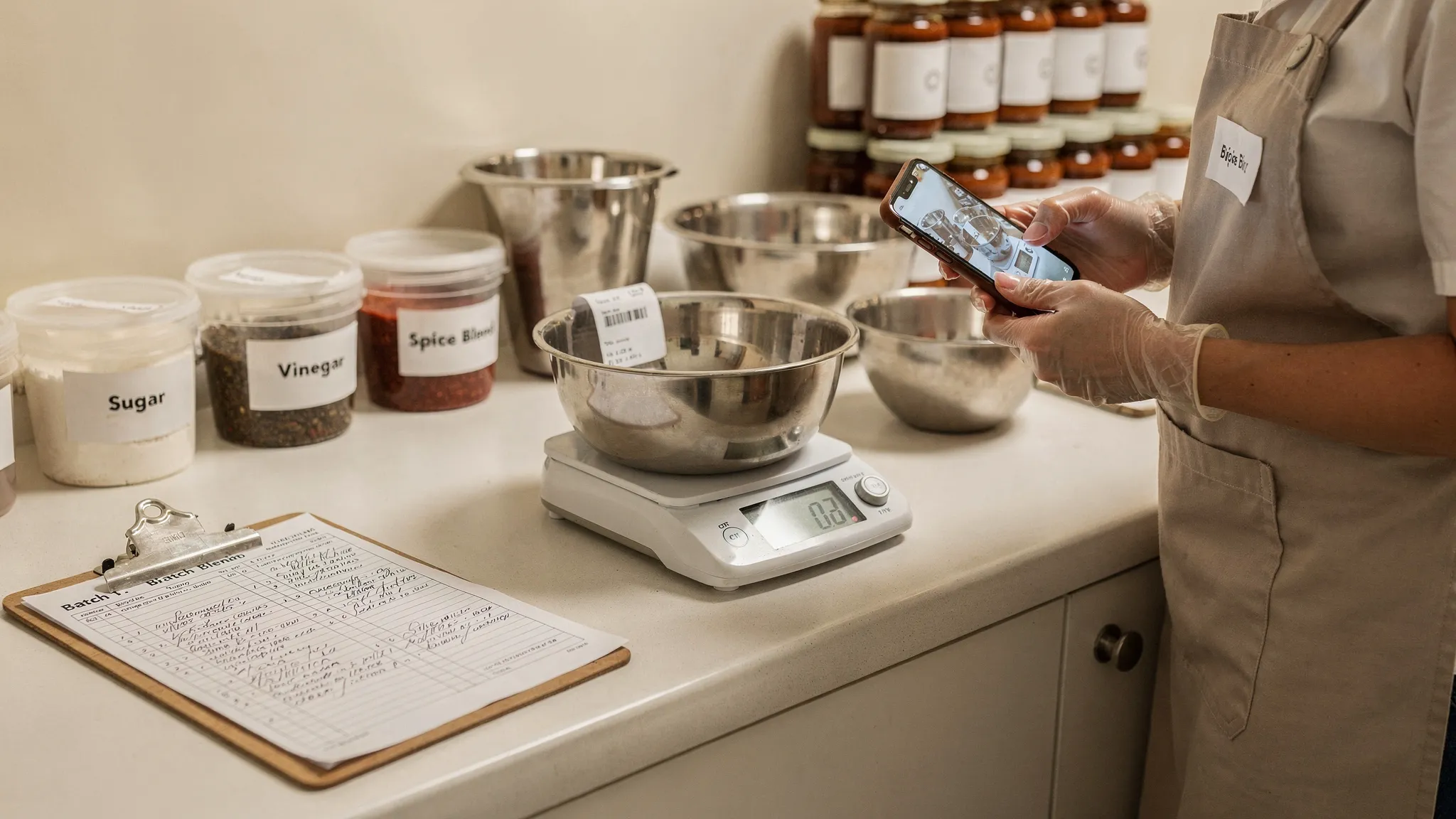
A practical yield workflow that does not disrupt your day
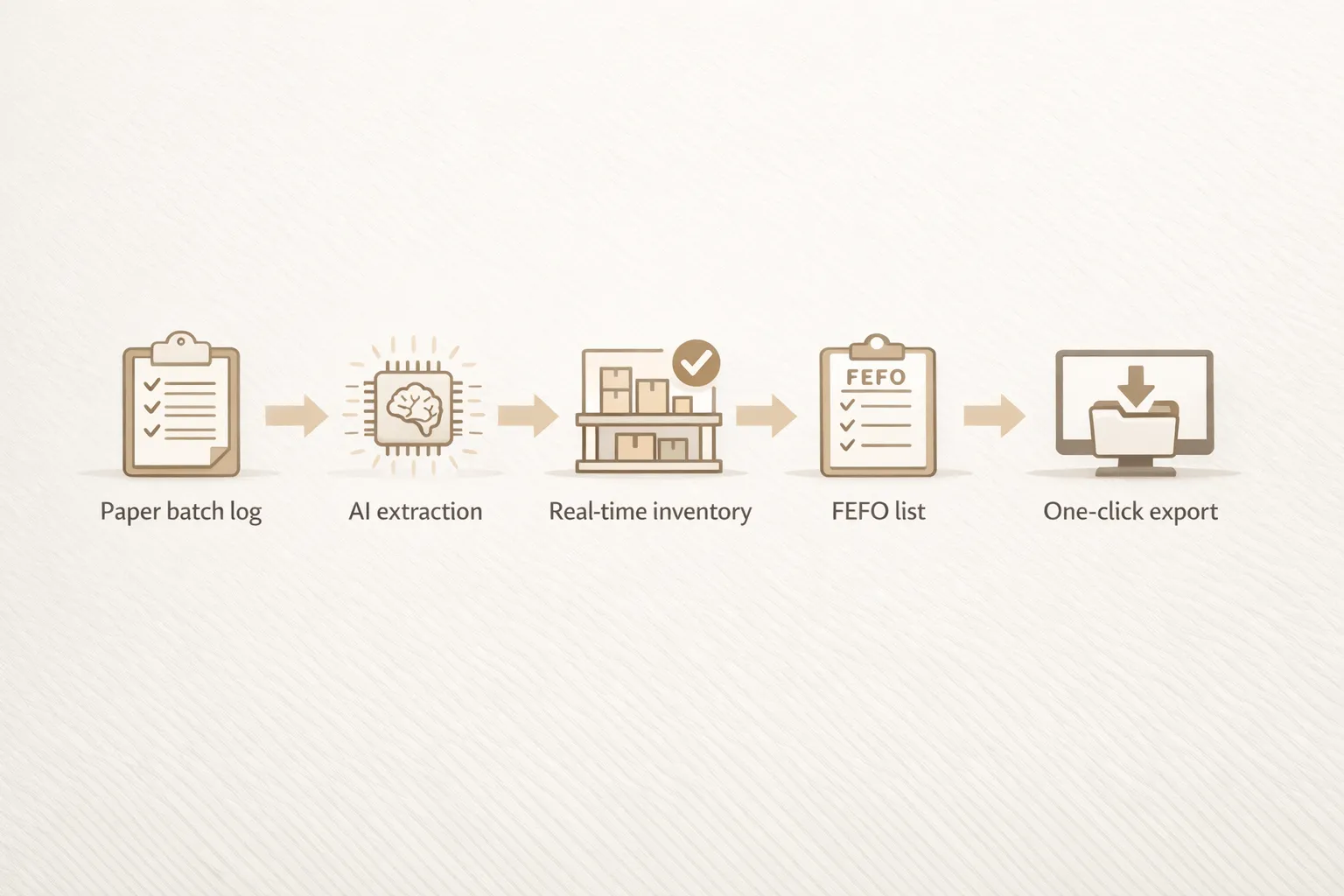
- Capture the numbers you already track. Keep using your batch sheets. Record inputs, finished packs, rework held, and scrap. Batch Better's AI-powered data extraction reads those fields directly, or calculates them if omitted.
- Confirm lots as you work. Use lot label scanning to tie inputs and outputs to the right lot codes in seconds, no typing and no transposed digits.
- Let the math check itself. Automatic data validation catches totals that do not add up and out-of-range entries before they create inventory drift.
- See inventory update in real time. As soon as a batch sheet is uploaded, real-time inventory tracking reflects true finished goods on hand.
- Move product first-expiry, first-out. Expiry and FEFO tracking surfaces what needs to move now, so you ship older lots first and avoid last-minute discounts.
- Keep your traceability clean. Instant lot tracing keeps a clear chain from ingredients to finished goods. If a supplier calls, you can respond fast with recall-ready record keeping.
- Export what auditors ask for, in one click. One-click export reports give you batch yields, lot movements, and expiry status without a spreadsheet marathon.
Nothing big changes on the floor. You still cook, cool, pack, and sign off. The difference is that your numbers work for you instead of against you.
Where yield data pays off right away
| What you see on the floor | What the data shows | Batch Better feature used | Practical fix |
|---|---|---|---|
| Finished case counts do not match what the system says | Net yield is lower than expected on specific days or shifts | AI-powered data extraction, automatic data validation | Recalibrate scales, tighten fill targets, confirm pack sizes on the sheet |
| Negative inventory on a top seller | Good output was recorded, lot code was mistyped | Lot label scanning, instant lot tracing | Re-scan labels at pack off, correct lots without re-entering the batch |
| Rework bins keep growing | Recovery percent is high but rework is not consumed | Real-time inventory tracking | Schedule rework into next batch, give it a lot code so it moves under FEFO |
| Discounting close-dated items | Multiple lots near expiry at once | Expiry and FEFO tracking | Prioritize pick lists by FEFO, create short-dated bundles |
| Time sink during audits or mock recalls | Batches, yields, and lot paths scattered across files | Recall-ready record keeping, one-click export reports | Produce batch yield and lot movement reports in minutes |
Cost accuracy without the spreadsheet sprawl
If yields are off, cost per unit is off. When you digitize yields per batch, the unit cost you see reflects the real process, including trim, moisture loss, and rework. That means margins by SKU are grounded. You can decide whether to adjust a recipe, a fill weight, or a price with confidence, not with a hunch.
Small drifts have big consequences. A few grams of overfill per jar, multiplied by a week of production, becomes a pallet of unplanned giveaway. With clear yields, you set a target and hold to it. You do not need a new ERP to do that — you need clean numbers in the system you already trust.
Cut waste, not corners
You can reduce your waste when you know, batch by batch, what became of every input. Here is how that looks in practice:
- Tighten portioning where it matters, not everywhere. Focus on the SKUs and shifts that show the biggest variance. Do not slow the whole line to fix a one-off.
- Use rework quickly and safely. With lot label scanning and FEFO, rework moves like any other inventory, so it gets used while still in spec.
- Bundle short-dated items with intention. Smart product bundling helps you turn close-dated singles into value packs, so you move product without cutting corners on quality.
Ready for audits and recalls, automatically
Yield data ties directly into traceability. When inputs and outputs are tied to lot codes, you can answer who made it, when, with what, and how much. If you fall under or mirror the FDA's Food Traceability Rule, clear lot-level movement and batch records make life simpler. See the FDA's summary of additional traceability recordkeeping requirements for certain foods here: FSMA 204 Traceability Rule.
With instant lot tracing and recall-ready record keeping, you can quickly isolate affected lots and volumes, then use one-click export reports to share what the auditor or buyer needs.
Plan production with confidence
Yields inform what you should make tomorrow. When you combine real yields with repurchase prediction, you set batch sizes that match demand without padding to cover unknowns. You can level production, reduce overtime, and avoid both stockouts and write-offs.
And when demand shifts, smart product bundling gives you options to move inventory that is still perfect but approaching its date. That is real waste reduction, achieved with data you already have.
Quick start checklist
- Pick one high-volume SKU and record inputs, good output, rework, and scrap clearly on the next three batches.
- Scan lot labels at pack off to lock in traceability while it is fresh.
- Let Batch Better extract the numbers, then compare net yield to your target.
- Use automatic data validation to resolve any mismatches before posting inventory.
- Review the FEFO list and move the oldest lots first.
The relief of clean yields
You do not need a big system overhaul to get control of yields. You need the numbers you already collect to flow into inventory and cost cleanly, every day. Batch Better makes that happen behind the scenes, so you can stay on the floor and keep quality high while cutting waste.
See how quickly clear yields can steady your operation. Start here: Batch Better.