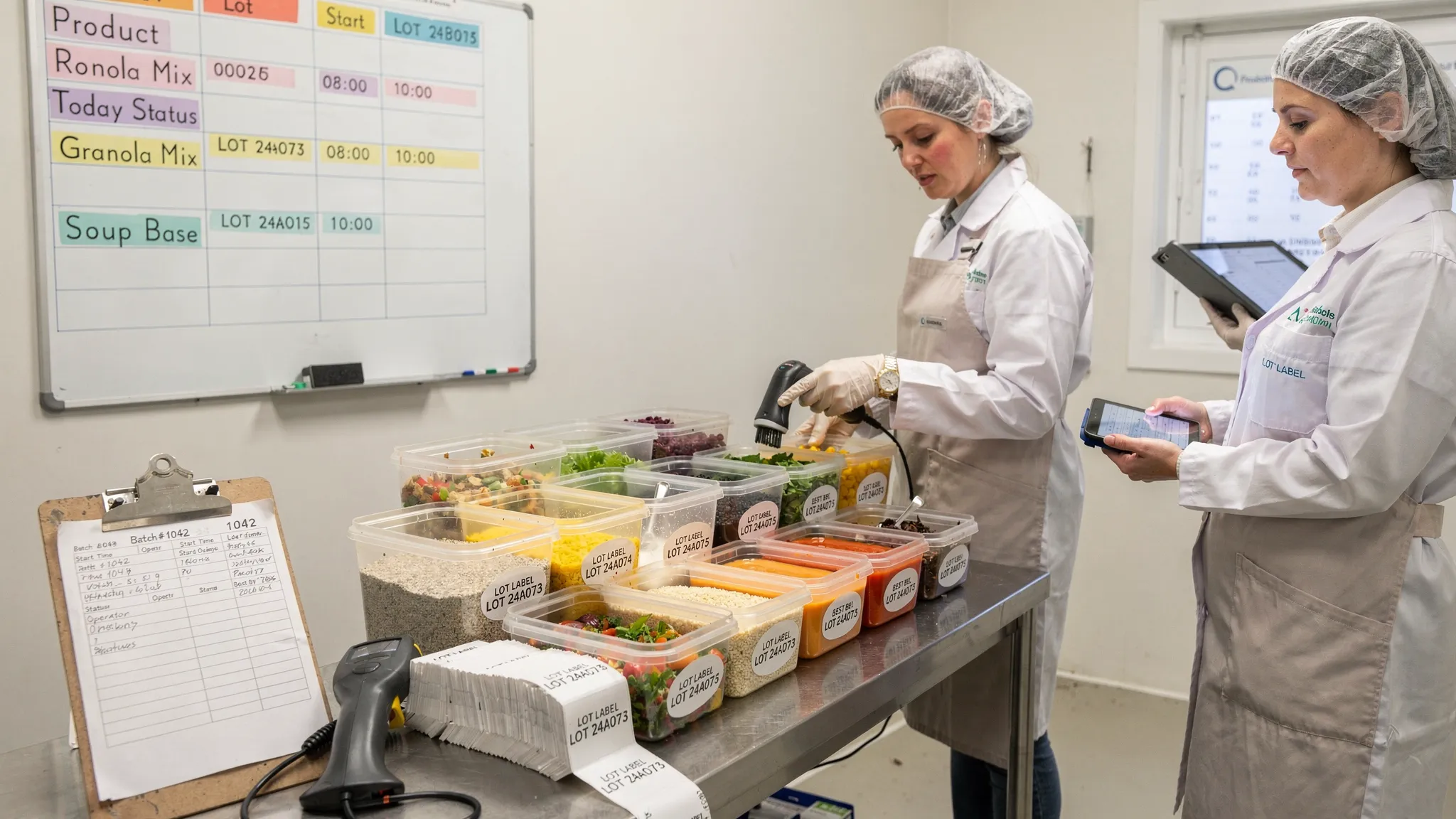
You are not building skateboards. In food and beverage, ingredients change by the hour, yields drift with moisture and trim, and dates decide what ships first. Generic materials requirements planning works fine for static parts, but it breaks under the realities of perishables, multi-stage processes, and audits. Use this checklist to pressure test your current setup and to evaluate any MRP you are considering, so you can plan production with confidence without ripping out the way your team already works.
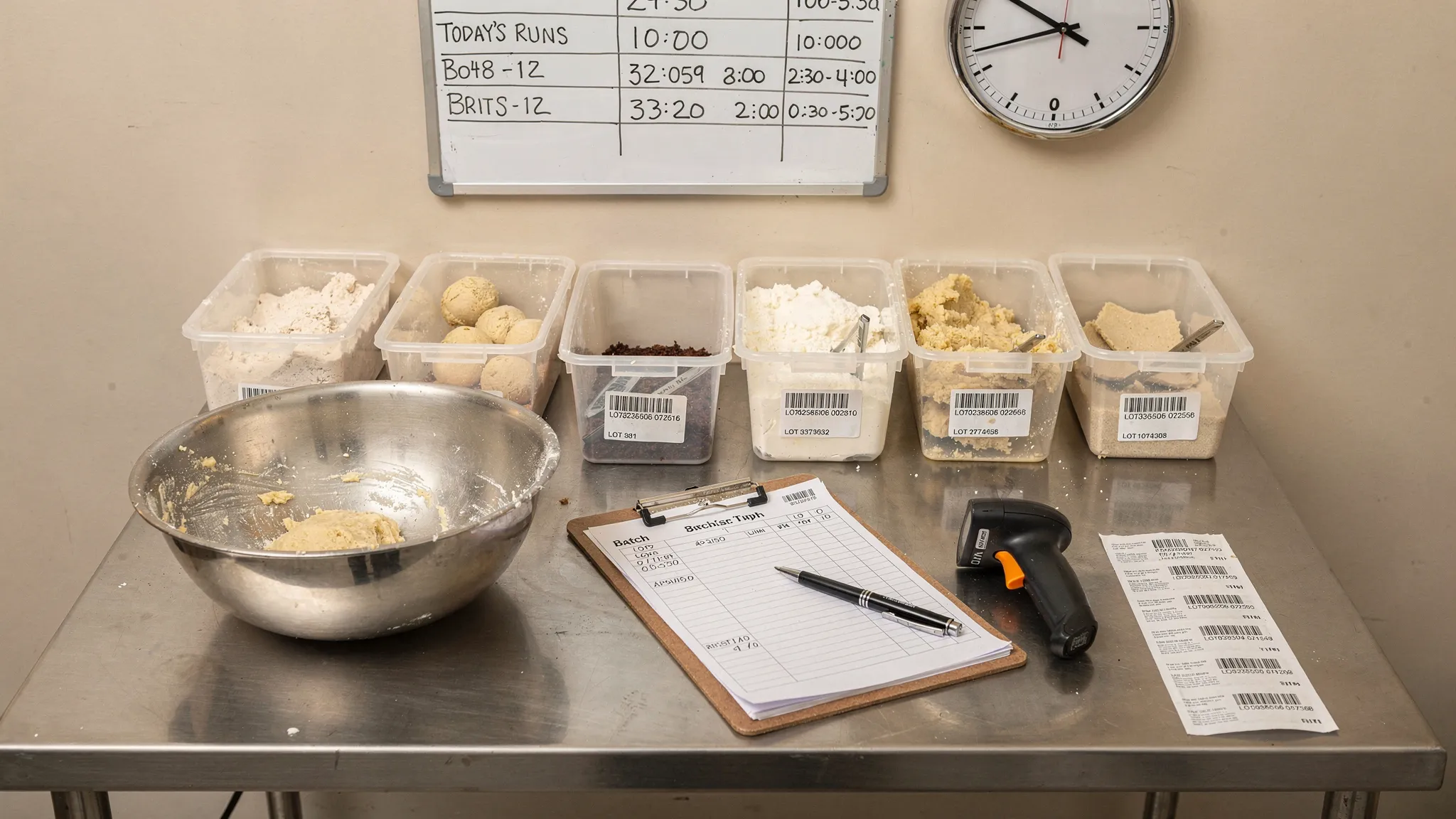
What materials requirements planning really means for food teams
Materials requirements planning is simple on paper. Start with demand, explore recipes, net inventory, then build a plan for what to buy and what to make. In a kitchen or a small plant, the plan only works if it understands how food behaves. That means it must handle multi-stage batches, shelf life and FEFO, dynamic yields and rework, lot-level traceability, and true batch-level costs. If those pieces are missing, the software will send you back to spreadsheets during the first busy week.
If you are producing your own food or beverage, use the checklist below to spot gaps early and avoid expensive add-ons later.
The food MRP checklist
| Requirement | Why it matters in food | What good looks like |
|---|---|---|
| Recipes as living BOMs | Batches scale, suppliers change, moisture shifts. | Recipes store percentages and target weights or volumes, scale cleanly, allow approved substitutes, and keep version history tied to lots. |
| Multi-stage production | You create intermediates and WIP, then transform them again. | Work orders support stages like prep, cook, cool, fill, pack, with clear handoffs and inventory updates at each step. |
| Dynamic yields and rework | Trim, cook loss, and rework change output every run. | Record expected yield and actuals by stage, capture rework and scrap, and push the true finished quantity to inventory automatically. |
| Expiration and FEFO | Dates control what ships and what gets scrapped. | Auto-calc best-by dates, enforce FEFO picks, block expired lots at issue and ship. |
| Lot-level traceability | You need backward and forward trace in minutes. | Scan and store supplier lots at receiving, carry lot lineage through every transform, and trace inputs to customers and shipments without manual joins. |
| Batch-level costing | Prices and yields move, margins need truth not averages. | Cost rolls up from actual ingredients, packaging, labor or overhead if tracked, scrap and rework, then lands on each finished lot. |
| Real-time inventory | Paper delays multiply waste and short picks. | Ingredients decrement when issued or scanned, finished lots post at pack, and WIP is visible between stages. |
| Units and conversions | Your plant mixes pounds, gallons, and eaches. | Accurate unit conversions with density where needed, no manual calculator needed at issue or receipt. |
| Allergen and claim controls | Label promises and cross-contact must be managed. | Ingredients carry allergen flags that flow to batches and finished lots, with alerts when a substitute changes the profile. |
| Lot label scanning | Manual typing creates silent errors. | Operators scan supplier and internal lot labels at receive, issue, and pack, with human-readable codes for quick visual checks. |
| Automatic validation | Catch mistakes before they move downstream. | Rules flag missing lot codes, expired lots, out-of-range yields, and unit mismatches in real time, not after an audit request. |
| One-click recall exports | Audits and mock recalls should not stop the line. | Standard reports export shipments, KDEs and CTEs for the FDA Food Traceability Rule, COAs, and inventory by lot in a searchable format. |
| Demand to plan connection | Making the right thing beats making more. | Forecasts turn into suggested buys and batches, with seasonality and customer repurchase patterns considered. |
| Vendor lead times and subs | Supply hiccups should not break the plan. | Item records carry lead times and approved alternates, and substitutions still preserve traceability. |
For background on the FDA Food Traceability Rule, see the FDA's overview of FSMA 204 and its Key Data Elements and Critical Tracking Events. The compliance date is January 20, 2026, so planning and exports need to be ready now. Reference: FDA Food Traceability Final Rule (FSMA 204).
If you want a quick refresher on traceability fundamentals, our guide breaks down internal versus external trace, KDEs, FEFO, and lot coding with practical steps: Track and Traceability: A Guide for Food Producers.
A fast, low-friction way to get there
You do not need a six-month ERP project to improve materials planning. Use your existing logs and labels, then add structure in days.
- Choose your top five SKUs by volume or spoilage risk. Define the stages they run through today.
- Pull the last 30 days of receiving and batch logs. List all lots used, all finished lots shipped.
- Build or clean up recipes with target yields and shelf-life rules. Note common substitutes.
- Turn on FEFO rules for those SKUs. Make sure best-by dates calculate automatically at pack.
- Start scanning lot labels at receiving and issue. Keep handwriting as a visual backup for week one.
- Run a micro mock recall on one finished lot, trace backward to inputs and forward to shipments. Fix any missing fields you discover.
- Reconcile batch-level costs using actual usage. Compare to your price list and update your cost view.
- Move the next week's runs into the system end to end. Review yield variance and waste each Friday.
This tight loop builds confidence and reduces risk without asking your team to change how they prep, cook, and pack. If you want a short routine for real-time checks, we outlined one here: Validate Data Fast Before Audits Hit.
KPIs that tell you MRP is working
| KPI | Why it matters | How to calculate or track |
|---|---|---|
| Spoilage rate | Direct margin hit from expired or short-dated inventory. | Spoilage quantity divided by total produced for the period, watch trend weekly. |
| Yield variance | Reveals planning misses and process drift. | Actual yield minus standard yield, by stage and by SKU. |
| Schedule adherence | Measures realism of the plan. | Planned batches completed on day divided by total planned, by stage. |
| FEFO compliance | Stops hidden shelf-life risk. | Percent of picks that followed FEFO, verified by lot dates. |
| Batch cost variance | Protects margin as prices move. | Actual batch cost minus standard cost, per finished lot. |
| Recall lookup time | Confidence during audits and fire drills. | Minutes to trace one finished lot backward and forward to shipments. |
| Inventory turns on perishables | Shows if you are buying and making at the right pace. | Cost of goods sold divided by average inventory, focus on short shelf-life items. |
Common pitfalls to avoid
- Static BOMs that ignore reality, then require manual "fixes" after every run.
- No FEFO enforcement, so the oldest product quietly ages in the back.
- Missing lot scans at issue, which breaks traceability through transforms.
- Treating yield loss as noise, not data, which hides true batch costs.
- Buying a generic MRP, then paying extra later for traceability and expiry features that food requires on day one.
How Batch Better supports food-grade MRP without disrupting your floor
Batch Better was built for small food and beverage producers who would rather be in the kitchen than wrestling with software. It turns the paper you already trust into reliable, recall-ready data, and it respects your current workflow.
- AI-powered data extraction digitizes your batch and receiving logs with minimal typing.
- Real-time inventory tracking, expiry and FEFO tracking, and instant lot tracing keep planning grounded in what is actually on hand.
- Automatic data validation catches missing lot codes, date issues, and out-of-range yields before they cause rework.
- Recipes and yield management capture your dynamic reality, and batch level costing shows true margins by lot.
- One-click export reports help with audits and recalls, including FSMA 204 KDE and CTE outputs.
- Lot label scanning makes traceability faster than handwriting without taking away the clipboard.
- Production forecasting and repurchase prediction connect demand to materials planning so you make what will move.
If you want more detail on measuring and improving yields with minimal disruption, this walk-through is a helpful companion: Yield Management That Cuts Waste, Not Corners.
Frequently Asked Questions
Do small producers really need materials requirements planning? Yes, but it does not have to be heavy. If you are scaling beyond a few SKUs, you already do MRP in your head and in spreadsheets. A food-grade system makes it reliable, expiry aware, and traceable without changing your core routine.
How do I plan when yields are never the same twice? Use expected yields to plan, then record actuals by stage. Let the system update finished quantities and cost based on what really happened. Over a few weeks you will tighten standards and waste will drop.
What is FEFO and how do I set it up? FEFO means First Expired, First Out. Your system should calculate best-by dates automatically, rank lots by remaining shelf life, and block expired lots at issue and ship. You should not rely on memory or sticky notes for this.
How does traceability fit into MRP? Every materials plan depends on lot-level truth. Scan supplier lots at receiving, carry lot lineage through every transform, and make sure you can trace a finished lot back to inputs and forward to customers in minutes. The FDA's FSMA 204 heightens this need, with a compliance date of January 20, 2026. See the FDA Food Traceability Final Rule for details.
Will scanning slow my team down? Not if it is done at natural pause points, like receiving, issuing to a batch, and packing. Scanning prevents rework and last-minute hunts for missing codes, which saves time net-net.
Can I start without redoing my entire process? Yes. Start by digitizing the paper you already fill out, enforce FEFO, scan lot labels at a few key points, and run a weekly micro mock recall. Improve in small steps and keep production moving.
The bottom line
Food is dynamic. Your planning must be too. If your materials requirements planning understands multi-stage batches, expiry and FEFO, dynamic yields, full traceability, and batch-level cost, you will spend less time fixing spreadsheets and more time making excellent product. Batch Better is purpose built for food and beverage producers, so you get the tools you need without upsells for the basics and without turning your floor upside down.
Ready to turn today's paper into tomorrow's plan? Visit Batch Better and see how fast you can put a food-grade MRP checklist to work.